We Made It Easy to Contact Your Senator or Representative
You shouldn't need a lobbyist to talk to your elected officials. Here's how Public Code US puts direct democracy back in your hands.
You Shouldn’t Need a Lobbyist to Talk to Your Senator
Here’s a reality check: right now, software vendors are spending millions of dollars lobbying Congress and state legislatures to keep government software locked up behind proprietary walls. They have dedicated teams, paid strategists, and access that most Americans will never get.
You have… a browser and a few minutes.
We think that’s enough. That’s why we built direct, one-click access to your senators and representatives into every single state page on this site.
What We Built
Navigate to your state on Public Code US — say, Texas, New York, or California — and you’ll find the complete contact information for every one of your elected federal officials:
- Your senior and junior U.S. Senators, with direct phone numbers and links to their official contact forms
- Your House Representative, based on your congressional district, with the same
No searching. No going back and forth between government websites. No wondering if you have the right person.
It’s all in one place, organized for action.
A Message Ready to Send
We know the hardest part of contacting a representative isn’t finding the phone number. It’s knowing what to say.
We took care of that too.
On every state page, you’ll find a pre-written advocacy message you can copy with a single click. It explains the public code issue clearly and persuasively, speaks to your representative in their role, and is short enough to actually get read. Paste it into the official contact form, customize it if you’d like, and hit send.
That’s it.
The message makes a simple, powerful ask: support policies that require publicly funded software to be publicly available. When taxpayers pay for it, taxpayers should own it. If you’d like to go deeper before you write, our Complete Guide and FAQ are free to download.
Why Direct Contact Works
You might wonder: does contacting my representative actually do anything?
Yes. Genuinely.
Congressional offices track constituent contacts. When the same issue comes up again and again — from real constituents, not form-letter bots — staffers notice. They brief their members. It shapes how legislators prioritize issues.
You’re not shouting into a void. You’re adding your voice to a record that gets reviewed.
The software industry knows this. That’s why they pay people to make those calls and fill out those forms on their behalf. The good news: you don’t need a budget to do the same thing. You just need to show up.
How to Do It Right Now
-
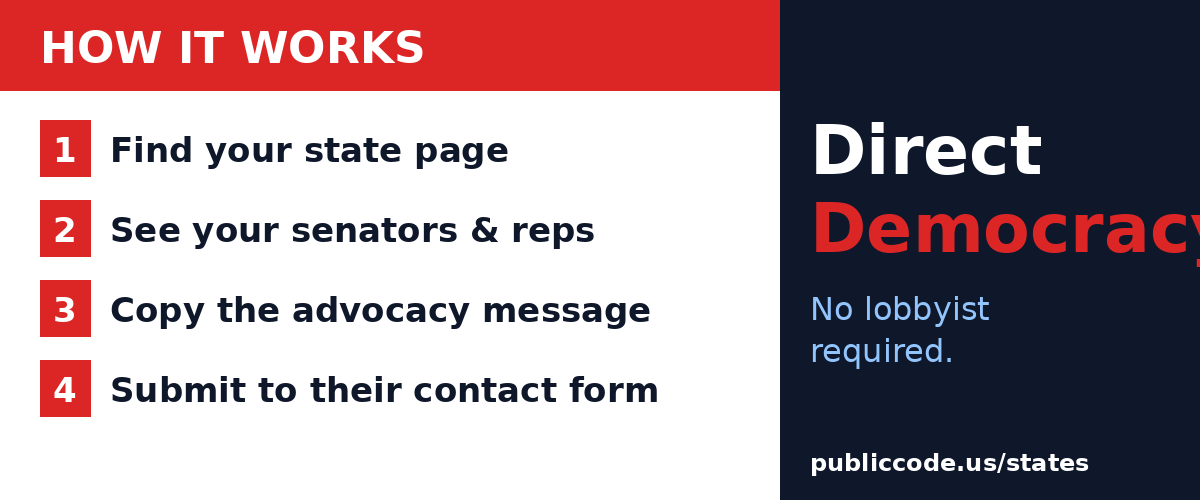
Go to your state page. Find it on the Campaign Map or navigate directly to
/states/your-state. -
Find your senators and representative. They’re listed with party, phone number, and a direct link to their contact form.
-
Copy the advocacy message. One click. It’s ready to go.
-
Paste it into the contact form. Open the link, paste the message, fill in your name and ZIP code, and submit.
-
Call too, if you can. Phone calls carry extra weight. A 30-second call to say “I’m a constituent and I support public code legislation” is one of the most effective things you can do. The numbers are right there on the page.
The whole thing takes less than five minutes. You could do it right now, before you finish reading.
The Bigger Picture
Signing the petition and running ballot initiatives are powerful. But so does direct legislative pressure — and they reinforce each other.
Some of the states in our campaign don’t have ballot initiative processes, meaning the only path to reform is through the legislature. For those states, contacting your representative isn’t a supplement to the campaign. It is the campaign. Learn more about how this works on our Learn page or Organizing Guide.
Even in states where we’re running ballot initiatives, letting your representatives know that constituents care about this issue builds the political will to make public code law — whether through the ballot box or through the legislature itself.
This Is How Change Happens
The public code movement didn’t win in Europe because governments suddenly decided to do the right thing. It won because citizens, advocates, and communities kept showing up. They signed petitions. They wrote letters. They called offices. They made the political cost of inaction higher than the political cost of reform.
We’re building the same movement here.
Your senator’s contact form is waiting. Your representative’s phone is ringing. The message is already written.
All you have to do is show up.
Find your state and contact your representatives →
Questions about the campaign or the legislative process? Visit our Learn page or read our Organizing Guide. New to the movement? Start with Welcome to Public Code US.