Open Source Is Worth $8.8 Trillion — And We're Leaving Most of It on the Table
Harvard researchers just put a number on open source software's economic value: $8.8 trillion. The federal government spends over $100 billion a year on IT contracts. The math isn't complicated.
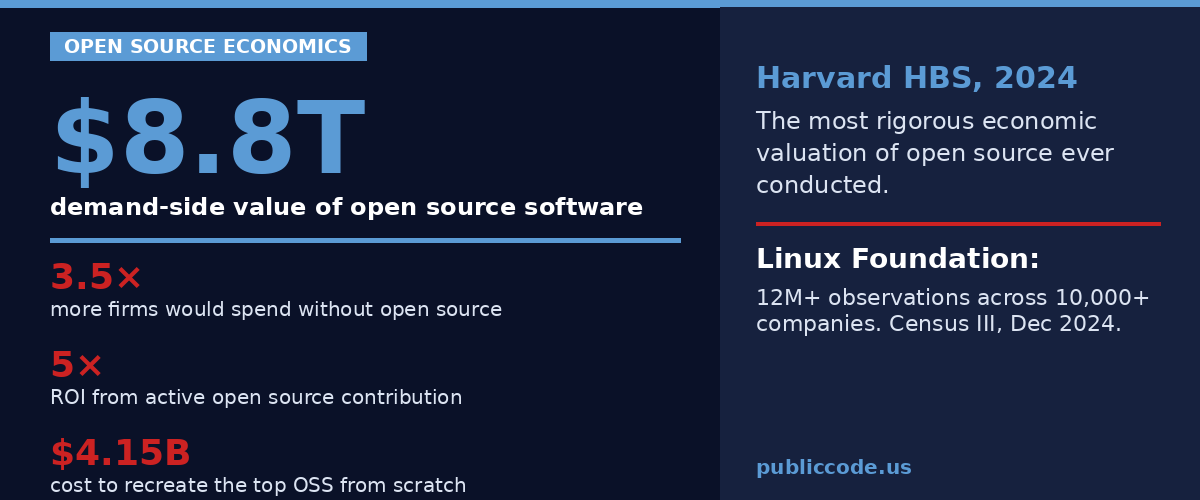
Open Source Is Worth $8.8 Trillion. We’re Leaving Most of It on the Table.
Last year, Harvard Business School researchers published a paper that should have made front-page news in every city hall, state capitol, and federal agency in the country.
The paper — “The Value of Open Source Software,” by Manuel Hoffmann, Frank Nagle, and Yanuo Zhou — put a number on something the tech world has known intuitively for decades: open source software is extraordinarily valuable, and nearly all of that value is given away for free.
The headline figure: $8.8 trillion.
That’s the demand-side value of the open source software ecosystem — what companies and governments would have to spend on proprietary alternatives if open source software didn’t exist. For context: the entire U.S. federal budget is about $6.8 trillion. Open source is worth more than that, and it’s available to anyone.
Now ask yourself: why is the federal government spending over $100 billion a year on IT contracts to build systems in the dark?
What the Numbers Actually Say
The Harvard study is the most rigorous economic valuation of open source software ever conducted. Here’s what it found:
- The supply-side cost to recreate the most widely used open source software from scratch: $4.15 billion
- The demand-side value — what firms would pay for equivalent proprietary software: $8.8 trillion
- Without open source, firms would need to spend 3.5 times more on software than they currently do
- 96% of that demand-side value is created by just 5% of open source developers — a reminder of how concentrated and fragile some of this infrastructure is
The Linux Foundation’s own research, published in early 2026, adds the investment angle: organizations that actively contribute to open source projects see a 2–5x return on investment. The top 100 open source contributors generated $23.2 billion in benefits from $3.9 billion in investment between 2018 and 2025 — a fivefold return.
These numbers aren’t advocacy talking points. They’re peer-reviewed economics.
The $12 Billion Question
The federal government spends approximately $12 billion annually on software licenses and development, and over $100 billion annually on IT contracts in total. A significant portion of that goes to proprietary systems that:
- Cannot be audited by the public
- Cannot be reused by other agencies
- Lock agencies into single-vendor relationships
- Are rebuilt from scratch every time a new contract is awarded
Meanwhile, Linux Foundation Census III — the most comprehensive audit of open source software in production ever conducted, drawing on over 12 million observations from more than 10,000 companies — shows that the software running most of the world’s infrastructure is open source. The cloud platforms. The web servers. The databases. The security tools. It’s already there. It already works.
The question isn’t whether open source is mature enough for government use. The question is why government isn’t using it — and requiring it — at scale.
The Reinvention Tax
We’ve written before about the unemployment insurance problem: California, Illinois, and New York each spent hundreds of millions building the same system, from scratch, during the pandemic. Each one failed. None of the code was shared. None of it is reusable. Taxpayers paid the “reinvention tax” three times.
This pattern repeats across every level of government, for every category of software. Elections systems. Tax processing. Medicaid eligibility. Court case management. DMV databases. Benefits applications.
The $8.8 trillion figure from Harvard captures the value of a world where software is shared, built once, and improved collectively. The federal government’s current procurement model is the opposite: build separately, own privately, reinvent repeatedly.
The reinvention tax isn’t a rounding error. It’s a policy choice.
The Linux Foundation’s Census: What’s Actually Running Government
The Linux Foundation and Harvard’s Laboratory for Innovation Science have been mapping which open source libraries are actually deployed in production environments — what’s really running the world’s software infrastructure.
Census III, released in December 2024, analyzed over 12 million instances of open source software in production at more than 10,000 companies. The findings:
- Cloud service-specific packages (AWS SDK, Azure SDK, Google Cloud libraries) are increasingly standard in production systems
- Python, JavaScript, and Java libraries dominate, with Rust growing rapidly
- Most production systems already rely on dozens of open source components — many of which are maintained by only a handful of contributors
- The security and sustainability vulnerability is concentrated: a small number of maintainers carry enormous responsibility for infrastructure that millions of systems depend on
This last point matters for government. When a government IT system is built on proprietary code, a security vulnerability is a vendor’s problem — and the government often doesn’t even know the vulnerability exists until it’s exploited. When a system is built on open source, those same vulnerabilities are findable by thousands of independent security researchers. Transparency isn’t a security weakness. It’s a security strength.
The Federal Open Source Policy: A Promise Partially Kept
The federal government made a commitment to open source in 2016. OMB’s Federal Source Code Policy (M-16-21) required:
- Agencies to consider open source before buying proprietary software
- Custom-developed code paid for by agencies to be shared across government
- At least 20% of newly commissioned custom code to be released publicly
A 2025 law upgraded the reuse requirement from policy guidance to a legal mandate: agencies are now formally required to share custom software.
This is progress. But there’s a gap between policy and practice.
Code.gov — the federal open source registry — has catalogued hundreds of government software projects, but reuse across agencies remains inconsistent. The 20% public release requirement means 80% of publicly funded custom code can still be hidden. And the “open source first” preference has never been implemented with the same rigor as the “cloud first” or “commercial first” preferences that drive most procurement decisions.
GSA has adopted an open-source-first approach for many of its own projects, pointing to reduced total cost of ownership and vendor lock-in avoidance. But GSA isn’t every agency. And the agencies that spend the most on IT — DoD, HHS, VA — remain heavily committed to proprietary development.
What $8.8 Trillion Should Tell Policymakers
Here’s the argument in its simplest form:
Open source software is worth $8.8 trillion in demand-side economic value — because it replaces software that would otherwise cost that much. The government already uses massive amounts of it. The government also spends over $100 billion a year on IT contracts, much of it for proprietary systems that duplicate work done elsewhere, cannot be reused, and cannot be audited.
A policy that required publicly funded software to be publicly available would not just save money on direct contract costs. It would begin to capture the compounding value of code that can be shared, improved, reused, and audited. It would convert a one-time contract expenditure into a durable public asset.
That’s what public code means in economic terms: stop paying the reinvention tax. Start capturing the open source dividend.
The Linux Foundation puts the active-contribution ROI at 3.6x for code contributions and 4.8x for foundation-level contributions. The Harvard economists say firms already using open source get 3.5x more software value than they pay for.
The federal government is one of the largest software consumers on earth. It could be one of the largest open source contributors. Instead, it pays proprietary vendors to build systems that disappear behind trade secrets the moment the contract is signed.
That is a policy failure. And it’s one we can fix.
What You Can Do
The economic case for public code is overwhelming. The political case is building. Help us make it undeniable.
-
Sign the petition. Every signature tells legislators that voters understand this issue and expect action.
-
Contact your representatives. Share the numbers. Ask where they stand. We’ve made it easy.
-
Read the research. The Linux Foundation’s Census III and Harvard’s open source valuation are publicly available. So is the GAO’s contracting transparency report. The evidence is there.
-
Share this post. The $8.8 trillion number is the kind of figure that cuts through. Use it.
The math is not complicated. The politics just needs the will.
Want more context? Read The $755 Billion Black Box on contracting transparency, or visit our Learn page for the full case for public code.
Sources
- “The Value of Open Source Software” — Hoffmann, Nagle & Zhou, Harvard Business School Working Paper 24-038, January 2024. [$8.8T demand-side value; 3.5x cost multiplier; $4.15B supply-side cost]: SSRN | HBS faculty page | Direct PDF
- Linux Foundation Census III — December 2024. [12M+ observations, 10,000+ companies, production OSS usage trends]: Press release | Full report PDF
- Linux Foundation ROI Report — February 2026. [2–5x ROI from active contribution; $23.2B benefits from $3.9B investment by top 100 contributors]: Press release | PR Newswire
- Federal Source Code Policy (OMB M-16-21) — 20% public release requirement; open source preference: Digital.gov
- Agencies required to share custom software — January 2025 law: Federal News Network
- GAO on federal IT spending and unrealized recommendations — GAO High-Risk: IT Acquisition and Management
- GSA open-source-first approach — FedScoop