Germany Is Saving $17 Million a Year by Ditching Microsoft. America Is Still Writing Blank Checks.
Schleswig-Holstein just migrated 30,000 government workers to open source and saved €15 million annually. France built a sovereign digital stack. Munich did it in 2003. What's America waiting for?
Germany Is Saving $17 Million a Year by Ditching Microsoft. America Is Still Writing Blank Checks.
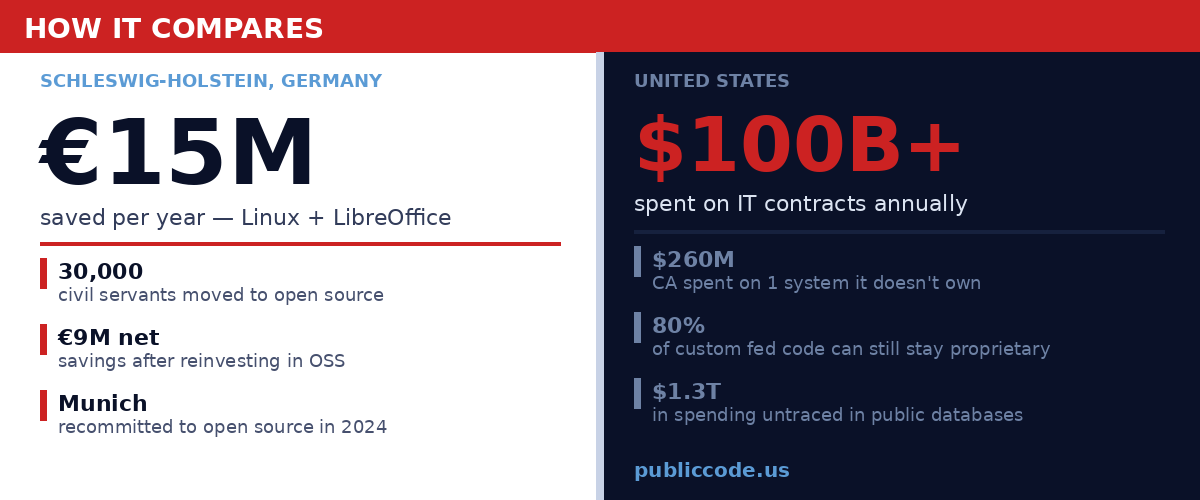
In 2026, the German state of Schleswig-Holstein will save €15 million — roughly $17.5 million — in a single year. Not from a new tax or a spending cut. From switching 30,000 government employees off Windows and Microsoft Office and onto Linux, LibreOffice, and Nextcloud.
They didn’t do this because it was trendy. They did it because it works. And they’re not alone.
France is building a fully open-source government productivity suite to replace Microsoft 365 and Google Workspace. Munich did it in 2003. The European Union is investing in sovereign open-source infrastructure at continental scale.
Meanwhile, the United States — which invented the internet, built Linux alongside the global open-source community, and houses the headquarters of every major tech company on earth — is still paying Deloitte, Microsoft, and Oracle to build government systems that nobody can audit, nobody can reuse, and nobody can verify are worth what was paid.
This is the gap we need to close.
The Schleswig-Holstein Story
Germany’s northernmost state began its open-source migration years ago, but 2026 is when the economics become undeniable.
- 30,000 civil servants, judges, and police officers have migrated from Windows/Microsoft Office to Linux, LibreOffice, and Thunderbird
- 80% of the ecosystem was already running LibreOffice
- The email system — 44,000+ mailboxes, 110 million emails — migrated to Open-Xchange and Thunderbird
- Annual savings: €15 million, primarily from eliminated Windows and Microsoft Office licenses
- Net savings after reinvesting in the open source ecosystem: €9 million per year
- The state published a formal Open Innovation and Open Source Strategy in November 2024 — not as a one-time experiment but as a permanent architectural commitment
This didn’t require a revolution. It required a decision: that software built with public money should be publicly owned, and that perpetual licensing payments to foreign corporations are not a law of nature.
The Munich Precedent
Munich started this in 2003 — when Linux was considered exotic and LibreOffice was still called OpenOffice. The city migrated 15,000 government desktops in a project called LiMux. The savings: €11.7 million.
The project was controversial. In 2017, after years of political pressure and aggressive Microsoft lobbying, Munich reversed course and went back to Windows. The decision was criticized even then as more political than technical.
But here’s the update: in October 2024, Munich doubled down again. A new five-point open-source plan and a new Open Source Program Office. The city acknowledged the 2017 reversal was a mistake and committed to rebuilding its open-source infrastructure.
Twenty years after Munich started, the lesson isn’t “open source failed in government.” The lesson is: it works, but it requires political will to survive industry lobbying.
France’s Sovereign Stack
France has gone further than any major democracy in building open-source alternatives to American platform dominance.
DINUM — France’s interministerial digital directorate — has developed La Suite Numérique: a fully open-source productivity suite covering collaborative documents, messaging, video conferencing, and file storage. It’s designed to replace Microsoft 365 and Google Workspace across the French government.
France also became the first government to formally endorse the United Nations’ Open Source Principles — a global framework for how governments should develop, share, and contribute to open source software.
The driving concern isn’t just cost savings. It’s sovereignty: the recognition that depending on foreign corporations for the software running government creates strategic vulnerability. When a government’s email runs on Microsoft, its documents on Google, and its databases on Oracle, it is not fully in control of its own infrastructure.
What Europe Is Building at Scale
The ambition doesn’t stop at national governments. There’s a serious, well-funded proposal called EuroStack — backed by research institutions and EU policy networks — calling for €300 billion in investment over a decade, including a €10 billion Sovereign Technology Fund to build federated, open-source alternatives to U.S. platforms.
The EU’s Cyber Resilience Act, which took effect in December 2024, requires baseline cybersecurity standards for digital products — a regulation that pushes both vendors and governments toward more auditable, open code. The Interoperable Europe Act mandates openness and standards in government IT. The EU Open Source Policy Summit in February 2025 framed open source explicitly as a continental security issue, not just a budget line.
Europe frames open source as a sovereignty and security question. The United States frames it as a procurement efficiency question. That framing difference produces fundamentally different policies — and different outcomes.
What America Has (And Hasn’t Done)
To be fair: the U.S. has federal open-source policy. OMB’s 2016 Federal Source Code Policy requires agencies to prefer open source and to share custom-developed code. Code.gov exists. GSA has formally adopted an “open-source first” approach for its own projects.
But the gap between policy and practice is enormous.
A 2025 law finally made software reuse a legal mandate rather than a guideline — meaning agencies must now share custom software across government. That’s progress. But:
- The policy still allows agencies to keep 80% of custom-developed code proprietary
- The “open source preference” in procurement has never been implemented with the rigor of the “cloud first” or “commercial off-the-shelf” preferences that dominate actual buying decisions
- The agencies that spend the most on IT — DoD, HHS, VA — continue heavily proprietary development
- Budget cuts in 2025 significantly reduced the staff at 18F and USDS, the internal teams most responsible for advocating open source approaches within the federal government
Meanwhile, the GAO’s High-Risk List has flagged federal IT acquisition and management as a persistent problem for decades. Over $100 billion in annual IT spending continues to flow through contracts that produce systems nobody can audit, reuse, or build on.
The Three Lessons From Europe
Lesson 1: The savings are real and compounding. Schleswig-Holstein’s €15 million in annual savings doesn’t count secondary benefits: reduced vendor lock-in, interoperability with other agencies, the ability to audit systems for security, and the removal of recurring license costs that inflate every budget cycle.
Lesson 2: The technology is ready. The obstacle is political. Munich’s 2017 reversal showed that open source works technically but requires sustained political support to survive industry opposition. The vendors with the most to lose from open source are also the vendors with the most resources to lobby against it. Every year the U.S. delays this transition, those vendors deepen their lock-in.
Lesson 3: This is about democracy, not just efficiency. France’s framing of digital sovereignty is ultimately the same argument we make in the United States: government software that serves the public should be answerable to the public. When the code is open, citizens, journalists, and researchers can verify what it does. When it’s proprietary, they have to take the vendor’s word for it.
Germany isn’t saving $17 million a year because it found a clever budget trick. It’s saving $17 million a year because it decided that public money should fund public infrastructure — and that includes the software.
America Should Lead, Not Follow
The United States created the conditions for the open-source ecosystem that Harvard now estimates at $8.8 trillion in economic value. American engineers wrote Linux alongside contributors from around the world. American universities and research institutions built the protocols the internet runs on.
We know how to do this. We’ve done it for 30 years.
What we haven’t done is apply the same principle to how government buys and builds software. Germany is saving tens of millions of dollars annually with that principle. France is building digital infrastructure that doesn’t answer to foreign corporations. Munich tried, was lobbied into reversal, and came back.
The question isn’t whether it’s possible. It’s whether we have the will.
We’re building that will. Join us.
-
Sign the petition. Make it political to oppose public code.
-
Contact your representatives. Tell them Germany figured this out. Tell them you expect America to lead.
-
Get organized in your state. The ballot initiative movement is how we create the political conditions for change.
-
Share this post. Schleswig-Holstein is saving $17 million a year. California spent at least $236 million on pandemic unemployment contracts for a system it doesn’t own. People need to hear both numbers.
Read more: The $755 Billion Black Box on federal contracting opacity. Open Source Is Worth $8.8 Trillion on the economic case for public code. New to the movement? Start here.
Sources
- Schleswig-Holstein €15M annual savings from Linux/LibreOffice migration — Heise Online (German tech publication), December 2025 | The Register
- Munich LiMux history and 2024 recommitment to open source — Studio Linux: “Munich’s Linux Experiment”
- France’s La Suite Numérique / DINUM sovereign digital stack — France becoming first government to endorse UN Open Source Principles
- EU Open Source Policy Summit, February 2025 — Open Knowledge Foundation blog
- EuroStack initiative: €300B proposal, digital sovereignty framing — EuroStack.eu | Bertelsmann Stiftung analysis
- Federal Source Code Policy (OMB M-16-21) — Digital.gov
- 18F and USDS open source advocacy; budget cuts in 2025 — GSA open-source-first: FedScoop