Schleswig-Holstein Hit 80%. The Migration Paid for Itself in Eight Months.
An update to our April story: Germany's open source migration crossed 80% of workstations, finished a 44,000-mailbox email move with zero data loss, and the payback math is now undeniable. France, Denmark, and China are joining the wave.
Schleswig-Holstein Hit 80%. The Migration Paid for Itself in Eight Months.
In April, we wrote about Schleswig-Holstein — the German state migrating 30,000 government workers off Microsoft and onto open source, saving €15 million a year. That was the plan on paper.
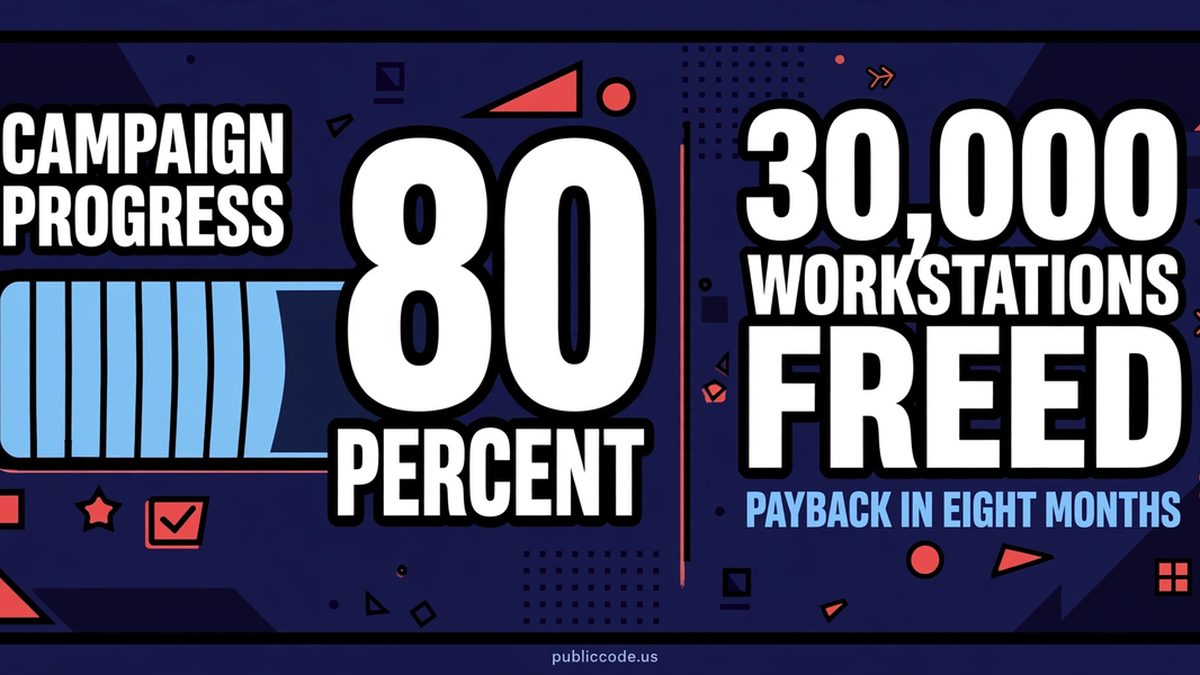
Here’s the update: it’s working. By August 2026, around 80% of the state’s 30,000 workstations were running LibreOffice. The email migration — 44,000 mailboxes, roughly 100 million emails and calendar entries — finished in October 2025 without a single loss. Nextcloud is replacing SharePoint step by step. Full completion of the state administration is planned for the end of 2026.
And the payback math, now that it’s real instead of projected: €15 million in license costs avoided every year, against €9 million in one-off migration and development costs in 2026. Payback in about eight months. After that, it’s €15 million a year, every year, forever — money that used to leave Germany for Redmond and now stays in the public sector.
This is no longer an experiment. It’s a completed business case.
The Wave Is Spreading
Schleswig-Holstein was the proof of concept. Here’s what’s happened since:
France moved its own desks to Linux. On April 8, 2026, DINUM — France’s interministerial digital directorate — announced it would move its own workstations, about 250 staff, from Windows to Linux. More importantly, it ordered every ministry to submit a plan for reducing dependence on non-European technology by autumn 2026. France isn’t just saving license fees; it’s treating foreign software dependence as a strategic vulnerability and demanding plans to end it. (We covered France’s sovereign open source stack, La Suite Numérique, in our April post.)
Denmark started the Office exit. Denmark’s Ministry of Digital Affairs began moving from Microsoft Office to LibreOffice in 2025. An honest correction to early reporting: initial stories suggested Windows itself would be dropped entirely, but Windows remains on many Danish government devices for now. The Office migration is real; the full OS exit was overstated. We note it because getting the details right is how the movement keeps its credibility.
China told agencies to drop Windows. In August 2026, reports said some Chinese government agencies were instructed to replace the specialized “Windows 10 China Government Edition” with Chinese-built Linux distributions. That’s not an open source story in the democratic sense — it’s a sovereignty story, and a reminder that every major power now treats dependence on foreign proprietary software as a strategic risk. When Beijing, Brussels, and Paris all reach the same conclusion about vendor dependence, it’s worth asking why Washington hasn’t.
Why This Update Matters
The standard objection to public code in government has always been practical, not philosophical: “Sure, open source sounds nice, but it can’t work at government scale. The migration will fail. The users will revolt. The savings won’t materialize.”
Schleswig-Holstein has now answered every clause:
- Scale? 30,000 workstations. 44,000 mailboxes. 100 million emails migrated without loss.
- Users? 80% migrated, completion on schedule for end of 2026 — not a pilot, the whole state administration.
- Savings? €15 million a year against €9 million one-off. Eight-month payback.
- Sustainability? The state published a formal Open Innovation and Open Source Strategy in November 2024 — a permanent architectural commitment, not a one-term experiment.
And it’s not alone anymore. France is planning ministry-by-ministry de-dependency. Denmark is mid-migration. Munich — which famously reversed its Linux migration in 2017 under vendor pressure — recommitted in October 2024 with a new open source plan and program office.
The question was never whether the technology works. It was whether governments have the political will to survive the lobbying. The answer, increasingly, is yes — everywhere except the country that invented the technology.
The American Ledger
Let’s put the two columns side by side, updated for autumn 2026:
Schleswig-Holstein: €15 million saved per year. Eight-month payback. Full completion end of 2026.
United States: Over $100 billion a year in federal IT spending, flowing through contracts that produce systems nobody can audit, reuse, or verify — while the internal teams that championed open source (18F, USDS) were dismantled in 2025.
Germany isn’t winning because it found a clever budget trick. It’s winning because it decided that public money should fund public infrastructure, and that perpetual license payments to foreign corporations are not a law of nature.
America’s move. Again. Still.
-
Sign the petition. Make it political to keep writing blank checks.
-
Contact your representatives. Schleswig-Holstein: €15M/year saved. Ask what your state’s Microsoft bill buys.
-
Get organized in your state. State governments buy the software. States can demand the code.
-
Share this post. Eight-month payback. Eighty percent migrated. Zero emails lost. The excuses are exhausted.
Read more: Germany Is Saving $17 Million a Year by Ditching Microsoft. America Is Still Writing Blank Checks. (our April 2026 deep dive) · Europe Just Bet €2 Billion on Public Code. America Is Still Writing Blank Checks. · You’re Paying the Vendor Lock-In Tax. Every Single Year.
Sources
- 80% of 30,000 workstations on LibreOffice by August 2026; 44,000 mailboxes; €15M/yr avoided vs €9M one-off; ~8-month payback; completion end of 2026 — europioneer.io, autumn 2026
- 44,000-mailbox migration finished October 2025; DINUM April 8, 2026 Linux move (~250 staff) and ministry de-dependency plans; Denmark Office-to-LibreOffice move and Windows correction; China August 2026 agency directive — pbxscience.com, September 21, 2026
- Schleswig-Holstein Open Innovation and Open Source Strategy, November 2024; Munich October 2024 recommitment — see our April 2026 post